
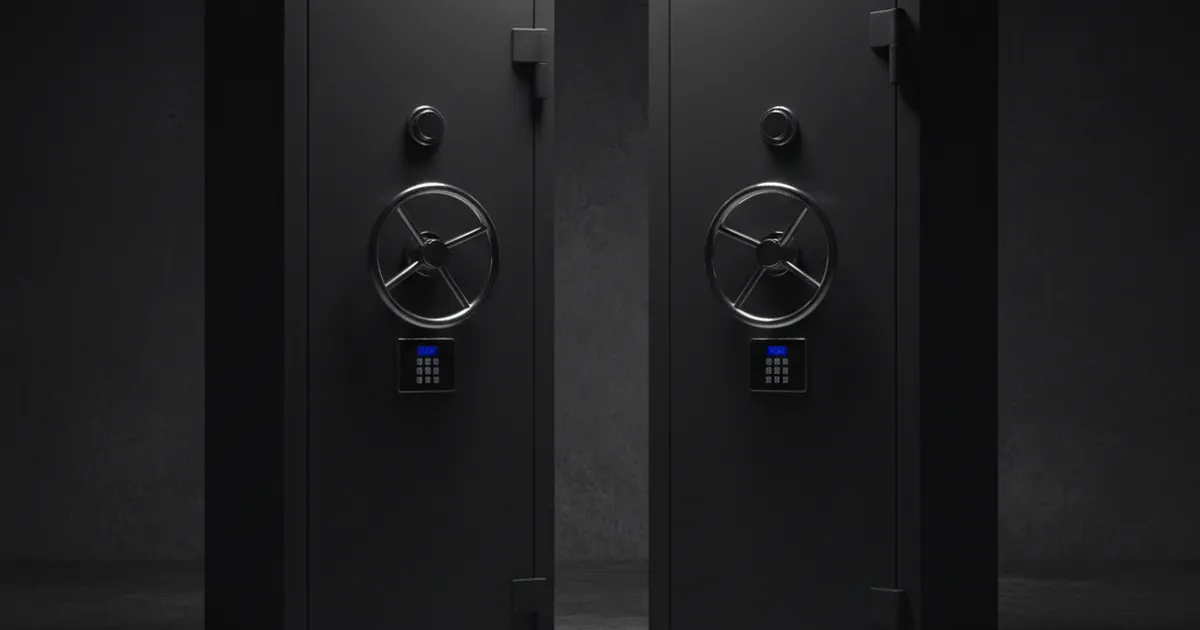
When evaluating boutique gun safe brands vs liberty sentrysafe, you are choosing between two entirely different storage philosophies. Boutique gun safes are specialized, rapid-access security units designed for specific locations like wall cavities or under-bed frames. In contrast, traditional mass-market safes are large, centralized steel vaults built primarily to maximize cubic storage capacity. For decades, the standard advice was to buy the biggest steel box you could afford and bolt it to the basement floor. But as home defense doctrine evolves, that conventional wisdom is showing its cracks. Today's instructors emphasize speed and accessibility over sheer volume.
What is the difference between boutique gun safes and traditional mass-market safes?
We may earn a commission from links on this page. This doesn't affect our editorial independence — all opinions are our own.

The short answer: mass-market safes sell you cubic footage and a price tag. Boutique safes sell you a specific access problem solved in a specific location. Those are genuinely different products, even when both have steel walls and a lock.
Traditional brands like Liberty and SentrySafe design around one question — how much can we fit inside? Steel gauge, cubic capacity, and a basic locking mechanism are the whole pitch. The result is a 400-pound box that dictates where your furniture goes and requires two guys and a furniture dolly to move six inches.
Key Takeaways
- Storage philosophy: Mass-market safes prioritize total capacity; boutique designs prioritize placement and access speed.
- Decentralized access: Boutique systems keep your primary home defense weapon out of sight but within arm's reach while you sleep.
- Form factor variety: Boutique options include in-wall, under-bed, and bedside mounts — not just a single centralized vault.
- Price range: Purpose-built boutique units start around $70–$170 for handgun safes and climb to $1,999 for large fireproof rifle safes.
- Trade-off reality: Neither category wins outright — the right choice depends on whether you need bulk storage or rapid-access placement.
Boutique brands approach storage differently. Instead of one central vault, they build purpose-specific units — in-wall panels that disappear behind a mirror, under-bed drawers that put a long gun within reach at 2 a.m., bedside mounts that keep a handgun accessible without sitting on your nightstand in plain view. Decentralized storage architecture keeps your primary home defense weapon out of sight but within arm's reach while you sleep.
The construction priorities differ too. Mass-market lines compete on sticker price, which means thinner steel and cheaper locking bolts at the entry level. Boutique units tend to spec heavier for their size — a wall-mounted safe fitting between 16-inch stud centers, for example, has to earn its keep in a tight footprint with no room to fake the bolt quality.
Neither category is automatically better. A Liberty Presidential makes sense if you're storing fourteen rifles and need serious fire rating. But if your real problem is getting a handgun out fast in a dark bedroom without waking the house, a 400-pound box in the basement solves exactly nothing.
Understanding these fundamental design differences naturally leads to how professionals actually stage their firearms today.
The shift away from the 'one giant box' storage method
One massive floor safe in the basement sounds responsible — until you're barefoot in the dark at 2 AM and your defensive pistol is three floors away behind a 500-lb door. That's the core problem. Big-box capacity is a storage win and a tactical loss.
The doctrine shift happening among serious instructors is called Layered Security — separating your immediate-action weapons from your long-term storage so you're never caught unarmed. One staged access safe near the bedroom. One deep-storage safe for the collection. Two different jobs, two different tools.
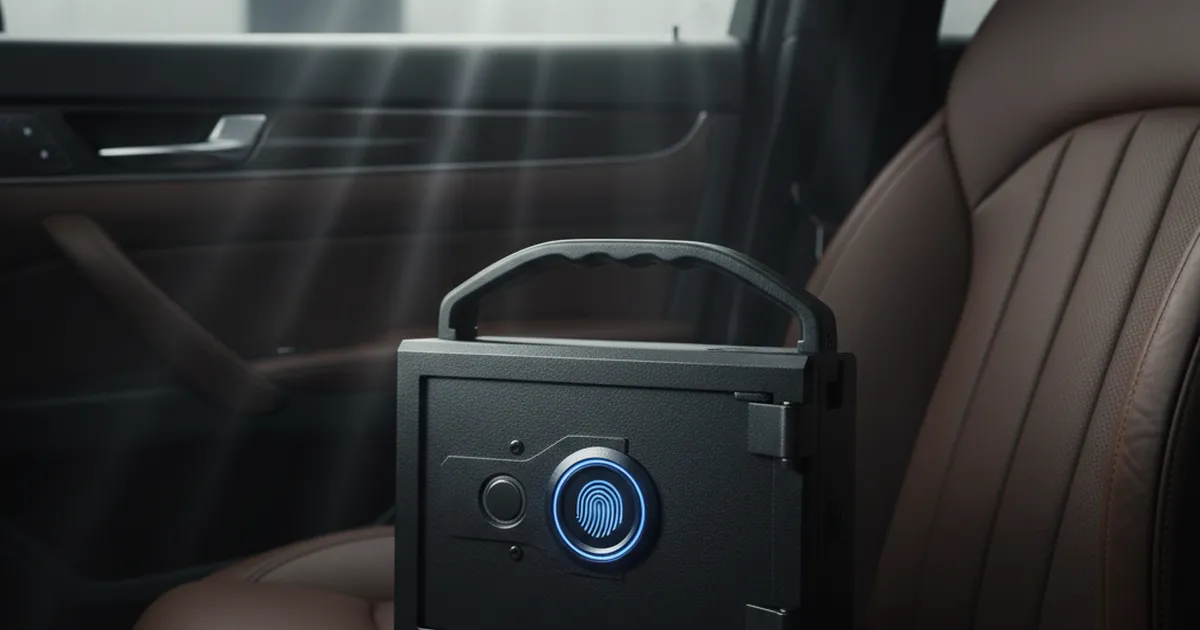
- Identify your immediate-action firearms. Your defensive handgun and possibly a home-defense carbine need to be within reach of where you sleep. A bedside unit like a biometric handgun safe — mounted or secured to the nightstand — gets you there in under three seconds. A 500-lb vault in the basement gets you there never.
- Separate staging from storage. Long guns you hunt with once a year belong in deep storage. The pistol you carry daily belongs staged. Mixing them in one safe means you're spinning a combination or punching a keypad at full stress, in the dark, with your hands shaking.
- Place access points where threats actually occur. Operational readiness means your firearm is where the threat will find you, not where it's most convenient to store it.
- Use deep storage for compliance and fire protection. A large fireproof cabinet rated for 30–45 minutes at 1,400°F handles your collection, your documents, your backup firearms. That's its job. Don't ask it to also be your 2 AM quick-draw solution.
The single-safe approach also creates a single point of failure. One forgotten combination, one dead battery, one safe that's bolted in the wrong room — and your entire storage system collapses at the worst possible moment.
The math is straightforward. A compact biometric bedside safe handles immediate access. A larger fireproof cabinet handles the collection. Together they cover both threat scenarios — the 2 AM intruder and the house fire. One giant box covers neither particularly well.
Once you accept the need for decentralized staging, the next step is evaluating how these specialized units physically fit into your living space.
Specialized footprints vs. big-box floor safes
A decentralized, space-optimized setup beats a traditional 500-pound floor safe on every metric except total capacity — and even that trade-off is closer than Liberty's marketing suggests.
A big-box floor safe consumes 4–6 square feet of floor space, often requires structural reinforcement under the subfloor, and announces itself to anyone who walks into the room. It's common to spend $800 on a Liberty or SentrySafe unit, then another $300 having a contractor beef up the floor joists. That's before the wife has her say about the gray metal monolith sitting in the corner of the master bedroom.
| Factor | Traditional Floor Safe (500 lb class) | Specialized Boutique Setup |
|---|---|---|
| Floor space consumed | 4–6 sq ft minimum | 0 sq ft (wall-mounted or under-bed) |
| Structural reinforcement needed | Often yes | No — studs or bed frame only |
| Concealment | Visible, identifiable target | Hidden behind drywall or furniture |
| Access speed | Single point, fixed location | Multiple access points throughout home |
| Partner acceptance | Low | High |
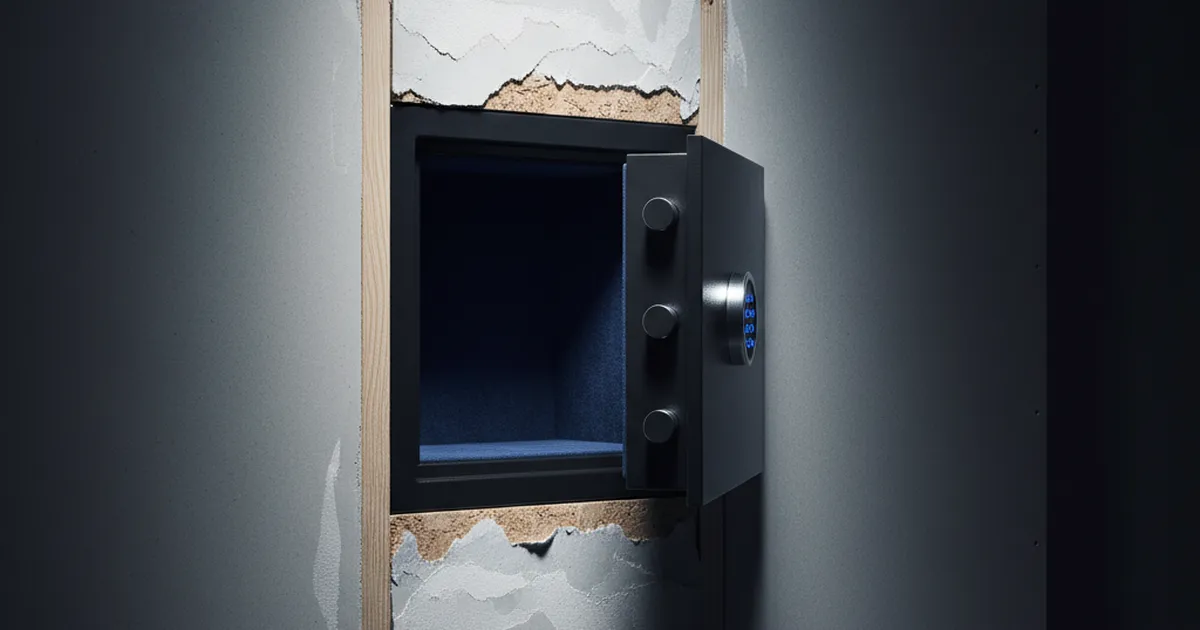
The wall-mount category solves the aesthetic problem directly. Standard American framing runs studs at 16-inch centers, which means your walls already have empty cavities sized for a purpose-built safe. That's dead space you're already paying to heat and cool.
The TactiBeaver Slate In-Wall Series mounts flush between those studs at $179.99 — the safe disappears behind a picture frame or a mirror, and your floor plan stays intact. No contractor, no floor reinforcement, no argument at the dinner table.
The honest trade-off: a single in-wall unit won't store a rifle collection. But that's not what it's for. It handles your bedside handgun and critical documents while a separate long-gun solution covers the safe room. Distributed storage also means no single point of failure — a burglar who finds one safe doesn't find everything.
The floor safe still makes sense for large collections requiring fire protection across 14+ rifles. For everyone else — a single defensive handgun, a couple of long guns, and a household that doesn't want to live around a gray metal box — the distributed boutique approach gives you better access geometry and a home that doesn't look like a pawn shop back room.
Of course, physical footprint is only half the equation; protecting your investment from environmental threats is just as critical.
What mass-market fire ratings actually cover (and what they don't)
Short answer: probably not the way you think. A 30-minute fire rating tells you the interior stayed below 350°F during a controlled lab burn. It says nothing about what happens when a fire hose hits that safe with several hundred gallons of water afterward.
That gap is where expensive optics, passports, and title documents get destroyed. The fire didn't kill them — the water ingress did. The pattern in post-fire safe teardowns is consistent: the safe held temperature, then soaked through during suppression.
Mass-market brands advertise 30-to-45-minute ratings prominently. Water mitigation gets a single line in the spec sheet, if it appears at all. That omission is doing a lot of work.
What the rating actually measures
UL fire ratings test interior temperature under sustained heat. They do not simulate a structure fire followed by suppression. Real house fires average 20–30 minutes before crews arrive, but water exposure during knockdown can last much longer.
Where tiered fire ratings change the math
A longer fire rating with documented water mitigation is a different product category than a 30-minute rating with no water sealing spec. The TactiBeaver Basalt Series runs from a compact document-box size — the BASALT XS, rated to 1,700°F for one hour — up through 45-rifle capacity, with the larger Pro models carrying one-hour protection at 1,400°F. The sizing tiers mean you're not buying a massive cabinet just to get a stronger fire spec.
That matters when you're storing NFA paperwork and a quality optic in the same unit. Surviving the heat only to drown in suppression water is a bad outcome regardless of what the marketing says.
Check what your safe's spec sheet actually says about water ingress before the next fire season. If it's blank, that's your answer.
Beyond environmental protection, the mechanism you use to access your firearm under pressure can be a matter of life and death.
Are Big-Box Biometric Locks Reliable Under Stress?
Short answer: mass-market biometric locks are unreliable when your hands are sweating, shaking, or both. The sensor technology in most big-box safes is optimized for dry, calm conditions — not a 0300 home defense scenario where your heart rate is at 160 and your palms are slick.
The core problem is False Rejection Rate, or FRR. Cheap optical sensors read surface moisture as noise, and adrenaline-induced sweating spikes FRR significantly. Your fingerprint geometry hasn't changed — the sensor just can't read through the sweat layer reliably.
Fine motor skill degradation under stress is well-documented, and it compounds the biometric problem. You're pressing harder, at a worse angle, with wetter fingers. That's three failure vectors hitting simultaneously.
Biometrics are faster than mechanical dials on paper — nobody disputes that. A quality capacitive sensor reads a print in under a second. But "on paper" and "at 0300 with a dog barking" are different tests entirely.
The distinction that actually matters is sensor quality. High-end boutique safes use capacitive sensors with sub-1% FRR under adverse conditions, ensuring your safe opens on the first touch even when your adrenaline is spiking and your hands are slick. The optical sensors in most mass-market safes can't make that claim.
The backup keypad matters more than most buyers realize. If you're buying a mass-market biometric, confirm the PIN fallback works one-handed in the dark before you trust it for home defense duty.
Conclusion: Building Your Layered Defense System
The upgrade verdict is straightforward: mass-market safes are adequate for basic compliance, but they leave real gaps in access speed and environmental protection. Split your thinking into two jobs. Your defensive firearm needs sub-three-second access—a dedicated bedside or in-wall biometric unit handles that. Your long guns and documents need fire and moisture protection—that's where a purpose-built fireproof safe earns its price tag.
One big box trying to do both jobs usually does neither well. Drag a Liberty or SentrySafe into a timed drill and it's easy to lose five seconds fumbling a keypad in low light. To fix this, explore in-wall storage options or learn how to build a layered security setup that fits your specific floor plan.
Pick your access tool based on response time. Pick your storage safe based on fire rating and capacity. Don't let a single purchase decision cover both requirements poorly. Your firearms are too important to compromise on either end of that equation.
Last reviewed April 23, 2026
Why Trust This Guide
Scope & Safe guides are written and reviewed by Marcus Reed and the Scope & Safe editorial team. Our recommendations are built on manufacturer specifications, published third-party data, and recognized testing standards — such as UL and ETL fire ratings — rather than manufacturer marketing, and every price and spec is verified against the seller's live product listing before we publish. We disclose our material connection to the brands we cover, including the Accufire and TactiBeaver stores — see our affiliate disclosure.


FAQ: Boutique vs Mass-Market Gun Safes
Is a boutique gun safe actually worth the higher price compared to Liberty or SentrySafe?
It depends on what you're protecting and where. Liberty and SentrySafe make decent entry-level boxes, but their fire ratings and biometric reliability have real limits at the budget tier. Boutique options tend to use thicker steel, tighter tolerances, and more honest fire certifications. If you're storing a single handgun in a bedroom, a $70 handgun safe does the job. If you're storing multiple long guns with documents, the spec gap between mass-market and boutique starts to matter in a real fire scenario.
Can I trust the fire ratings on Liberty and SentrySafe products?
Treat them as a starting point, not a guarantee. Many mass-market fire ratings are based on internal testing at controlled temperatures, not independent third-party certification. SentrySafe's lower-tier models often rate for 30 minutes at 1,550°F — but residential fires can burn hotter and longer. Boutique fireproof safes that publish independent UL certification give you a verifiable number. Always check whether the rating covers paper documents (451°F internal threshold) or digital media (125°F), because those are very different standards.
Are biometric locks on mass-market safes as reliable as boutique brands?
Generally, no. Budget biometric modules — common on SentrySafe and lower Liberty tiers — use capacitive sensors that struggle with wet, cold, or calloused fingers. Boutique brands tend to source higher-grade optical or capacitive sensors with faster read times and better rejection rates. If you need fast access under stress — say, 0300 with adrenaline running — sensor quality is the difference between a two-second open and a three-attempt lockout. Always confirm a backup entry method (keypad or physical key) regardless of brand.
Do boutique brands offer better options for small spaces and apartment living?
Yes, and this is one area where the boutique category genuinely pulls ahead. Mass-market brands default toward large floor safes that assume you have a dedicated room. Boutique lines include purpose-built wall safes, under-bed units, and compact bedside options at varied price points — a wall-mounted biometric safe at $179.99 fits between standard 16-inch studs and disappears behind a picture frame. That kind of footprint-specific design rarely shows up in Liberty's or SentrySafe's standard catalog without a significant price jump.
How many safes do I actually need for a layered home defense setup?
Most households with a defensive handgun and a few long guns are well-served by two: one fast-access bedside unit for the carry gun, and one larger fireproof safe for rifles and documents. A single giant floor safe is convenient to buy and inconvenient to use at 0300. The layered approach — quick-access near the bed, secure storage elsewhere — costs roughly the same as one mid-tier Liberty floor safe when you shop boutique options at the $70–$200 range for the bedside unit and $500–$1,200 for the main safe.
What specs should I actually compare when shopping boutique gun safe brands vs Liberty or SentrySafe?
Focus on four numbers: steel gauge (lower is thicker — 12-gauge beats 14-gauge), fire rating duration and temperature with the certifying body named, locking bolt diameter and count, and interior cubic footage against your actual gun count. Manufacturer marketing copy is noise. A safe rated at 1,400°F for 45 minutes with a named independent test is a real spec. "Fire resistant" with no temperature or duration listed is not. Compare those four numbers side by side, and the boutique-vs-mass-market decision usually makes itself.